
The performing arts sector is entering a new phase of digital transformation, where performance tech is redefining how talent is discovered, evaluated, and supported. As auditions, casting processes, and artistic recruitment increasingly move online, the need for solutions that balance efficiency with human connection has become critical.
Among the startups shaping this shift is Lanced, a CultTech Accelerator alumni that has experienced significant growth since its early days in the programme. Founded by former freelance dancer Wouter Vertogen, the platform is building digital infrastructure tailored to the realities of performing arts professionals, rethinking how artists present their work and how companies manage talent discovery.
In this conversation, Vertogen reflects on the evolving role of performance tech in the performing arts ecosystem, the structural challenges artists face today, and how Lanced is contributing to more sustainable, transparent, and future-ready career pathways. As the sector navigates rapid technological change, platforms like Lanced are not only adapting to new workflows — they are actively reshaping the foundations of artistic recruitment and professional visibility.
How do you see the current state of the performing arts industry in terms of digital transformation? What role do you think technology will play in shaping the future of auditions, casting, and artistic recruitment?
A lot is happening at the same time right now. What I genuinely notice, and appreciate, is that the rate of digital adoption is finally increasing. For a long time, the performing arts sector wasn’t known for moving quickly when it came to technology, but that’s clearly changing. Artists and companies are no longer asking “what is this?”, they’re actively trying to work with new tools.
When it comes to auditions and castings specifically, the reality is that the process has already shifted online. The first round almost always happens digitally now, through emails, Google Forms, or file uploads. The issue isn’t that auditions went digital… it’s that they did so without rethinking the experience.
Talent gets lost in inboxes. The human connection disappears. What’s missing is the magic of being in a room together; the nerves, the energy, the presence. At the same time, it’s simply no longer sustainable to have hundreds or even thousands of dancers physically show up for an open call.
So the real question isn’t whether auditions should be digital, but how. At Lanced, we focus on facilitating the digital-first round in a way that brings back care, intention, and humanity. Technology shouldn’t flatten talent; it should help it be seen.
What are the biggest challenges that performing arts professionals face today, and how do digital solutions like Lanced help overcome them? Have you noticed any shifts in industry demands or priorities since launching the platform?
Artists face challenges on many levels! I was a freelance dancer myself, and people often underestimate how much there is to manage beyond finding work. You’re dealing with taxes, pensions, training, visibility, and long-term career decisions all at once.
Sustainability is the key issue. It’s not just about talent. It’s about whether you can build a career with longevity. This is a tough industry by nature, with more artists than available jobs, and a very high dropout rate as a result.
Digital tools can reduce friction. Lanced offers artists a professional, focused environment where their work can be presented properly without getting lost in the noise of social platforms. It’s about creating a space for intentional, professional connection.
Since launching Lanced, I’ve definitely seen a shift. There are more initiatives to support artists and greater openness to technology. Companies are increasingly recognizing that digitizing core processes isn’t just about efficiency; it’s about fairness, clarity, and responsibility toward the people they work with.
What’s next for Lanced? Can you give us a glimpse of what’s on the horizon?
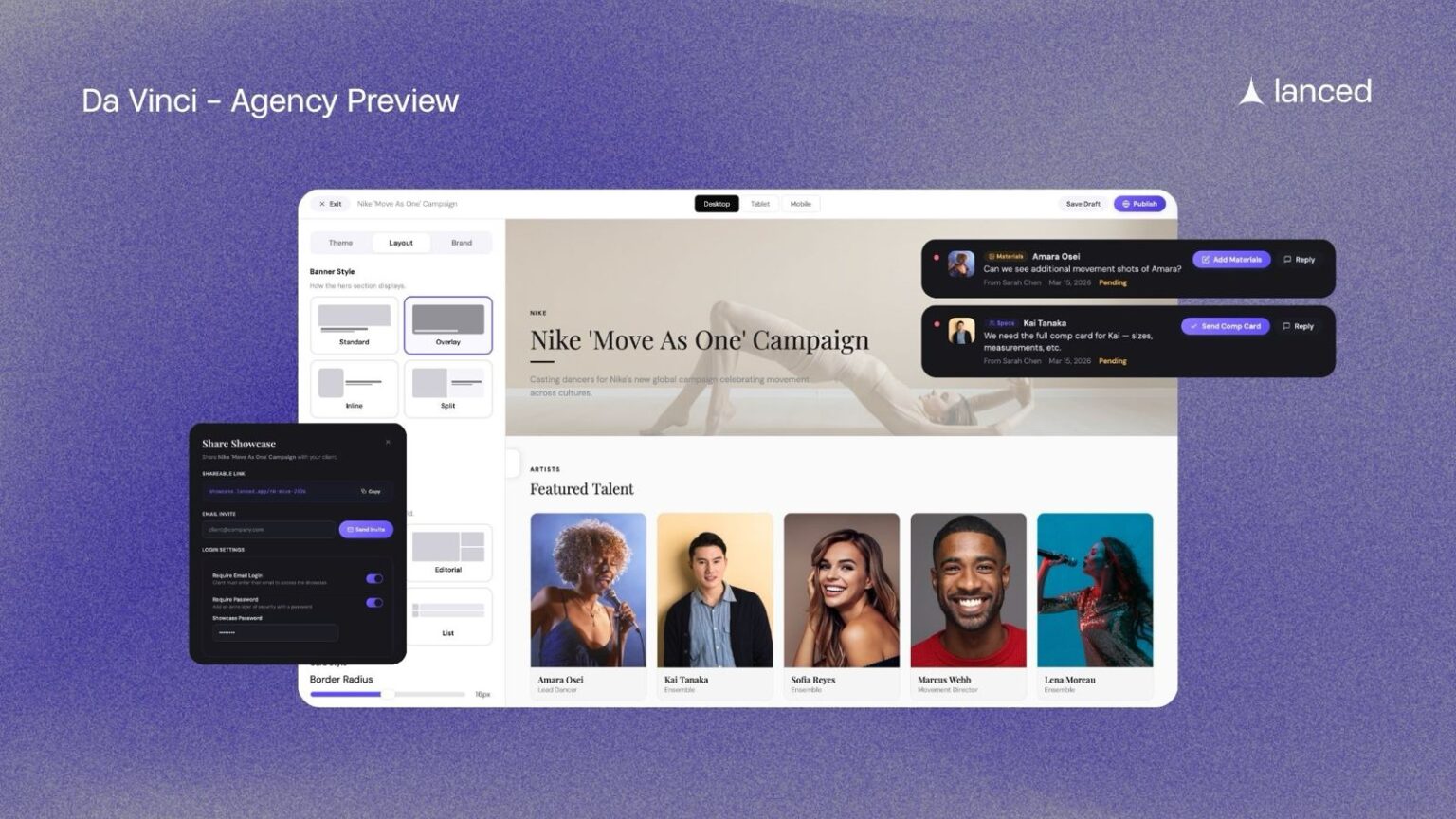
We’re currently building towards Da Vinci, our next major platform release. It’s a full redesign of the experience on both sides, for artists and for companies, based on everything we’ve learned over the past years of working closely with the industry.
On the artist side, one feature I’m particularly excited about is Artist Studio, which is already in beta. It lets artists turn their Lanced profile into a fully functioning portfolio website, with a custom domain and full control over how their work is presented. It also introduces more insight into the application process for artists, setting the stage for future expansions into matching and recommendations.
On the company side, we’re launching at least 50 new features and an entirely new Agency experience. Some are smaller tweaks, others are complete reworks. The core product of Lanced works and sells; now it’s about expanding the use cases and delivering value year-round. The input comes directly from our customers. We run constant feedback loops with artistic teams and with artists, through events like our Visibility Labs, where knowledge and input flow both ways.
The philosophy behind Da Vinci is simple: from customizability to scalability. Less friction, but more control. Clearer processes. Better overview. Tools that support artistic decision-making instead of getting in the way. That’s what we’re building towards.
When you started Lanced, what was your initial vision, and how has it evolved since going through the CultTech Accelerator? What were the most important lessons you took from that experience?
Lanced originally started as a career development platform for creative freelancers, specifically freelance dancers. That idea still sits at the core of what we do. When you think about career development, you inevitably think about work and opportunities, which led us to auditions and castings.
Early on, we faced a simple but important question: why would companies use our platform if there were no artists there yet? That pushed us to rethink how auditions and castings were managed on an administrative level. From that insight, we built our audition management tool for companies, which became our entry point into the market.
We joined the CultTech Accelerator at a very early stage, with a rough MVP. Since then, the platform has gone through many iterations, but the North Star has always remained the same. What the accelerator really helped with was formalizing our thinking, learning how to translate a mission-driven idea into something that could be commercially sustainable and viable in the long term.
You’ve launched several new features and updates over time. What guides your decision-making process on what to develop next? How do you balance speed and careful planning in your product roadmap?
The way we work has changed dramatically in recent months. We’ve restructured into a fully AI-native team. AI is now fully embedded in how we build, test, and ship. I can now go from idea to a working prototype within 24 hours using tools like Claude Code, and have it in front of real customers for feedback the same week. That’s a fundamentally different pace than even a year ago, and for a startup our size, it’s a serious advantage.
That speed matters because validation is what drives our roadmap. The more customers request something, the higher its priority. We don’t really build based on one-off requests anymore; features need to be repeatedly validated by users, or be such an obvious improvement that the use case is immediately clear. Our users drive our roadmap. Always.
For major expansions, we want to validate before we commit. Being able to prototype that quickly means we can put something tangible in front of customers early, learn from their reactions, kill bad ideas faster, and double down on what works with real confidence. The roadmap hasn’t just sped up; the entire feedback loop has compressed.
That said, even small changes can have huge implications in a live system where people are actively applying for work. Especially in critical processes like auditions and castings, where mistakes aren’t an option. So the speed is there, but never at the cost of care.
You’ve been bootstrapped from the start. Where are you today, and what advice would you give to other founders considering that path?
Honestly, bootstrapping has simultaneously become easier and harder. On the one hand, the barrier to building has never been lower. You don’t need €200k to build an app anymore. We code with AI tools daily, and what’s possible for a small team today would have required an entire engineering department just a few years ago. But that’s exactly what makes it harder, if everyone can build, tech alone is no longer a moat. You have to rethink what your actual edge is.
And then there’s the other side: getting people’s attention and actually selling. Especially in a niche market like ours, there is so much noise. You need a strong, distinct channel to unlock growth; you can’t just rely on the product being good.
For us, the edge has been brand and positioning. We’ve invested heavily in how Lanced looks, feels, and communicates. And then behind that brand, you need a product that delivers so much value and ease that people stay. That combination, strong positioning paired with a tool people genuinely can’t go back from, is what’s made bootstrapping work for us.
That said, bootstrapping is tough, and at some point you hit a ceiling. We’re nearing ours, which is why we’re actually in the process of raising our first round. Four years of building, testing and understanding our customers, a product the market has validated, and now the fuel to scale it. That’s the position you want to fundraise from. And I wouldn’t have done it any other way!
The intersection of culture and technology is evolving rapidly. What innovations do you think will be game-changers in the performing arts sector over the next five to ten years?
The performing arts will always be human-centered. Live performance, presence, and shared experience are irreplaceable. I don’t really see AI playing a meaningful role inside the creative process itself.
Where I do see enormous potential is behind the scenes. AI can dramatically improve how administrative work is handled, making organizations more efficient and freeing up time for creative work.
In terms of audience experience, technologies like AR, XR, and VR are exciting because they add layers to performance and open up new forms of shared experience, potentially on a global scale. We’re still early, but I believe these technologies will gradually become part of how we experience performance together.